Proposta per risolvere la crisi climatica mondiale
Progetto assorbimento CO2
Per comprendere il fenomeno “effetto serra” è indispensabile conoscere almeno a grandi linee la storia della nostra atmosfera ed in particolare la storia dell’O2.
La nostra atmosfera non è sempre stata così come noi la conosciamo oggi. Circa 3,8 miliardi di anni fa, periodo in cui compaiono le prime tracce di organismi viventi, la pressione parziale dell’O2 era circa un millesimo di quella attuale. Il passaggio da atmosfera riducente ad atmosfera ossidante è avvenuto circa 1,8 miliardi di anni fa. Ciò è stato possibile grazie all’invenzione della fotosintesi clorofilliana secondo la nota reazione:
6 CO2 + 6 H2O → (energia solare) → C6H12O6 + 6 O2
attraverso l’energia solare si combina anidride carbonica ed acqua per produrre glucosio con emissione di ossigeno libero.
Si può ragionevolmente affermare che praticamente tutto l’ossigeno presente in atmosfera è stato prodotto deidrogenando l’acqua ad opera degli organismi fotosintetizzanti. Tale massa di ossigeno ha come corrispondente, a meno delle dovute proporzioni e tenuto conto della quota di O2 che è stata consumata ad opera dell’ossidazione delle rocce superficiali, la massa di combustibili fossili presenti nel sottosuolo valutata intorno ai 1022 g . Qualora noi estraessimo ed ossidassimo (bruciassimo) tutto il combustibile fossile presente nei giacimenti dovremmo utilizzare tutto l’ossigeno atmosferico, anzi, come dicevamo poc’anzi, c’è più combustibile che ossigeno per via della quota consumata per ossidazione rocciosa.
Estraendo e bruciando combustibili fossili pertanto è come se ci stessimo via via riportando ad una condizione di atmosfera primordiale, pre-vita o per meglio dire pre-fotosintesi.
Quello che noi osserviamo oggi come evidente e progressivo riscaldamento globale è comunque riconducibile a fenomeni che hanno tutti una radice comune, l’opera della specie Uomo che in questi ultimi 100 anni ha incrementato in modo esponenziale il consumo di energia. Osservando il fenomeno dal punto di vista termodinamico, possiamo considerare il nostro pianeta come un sistema chiuso, possiamo scambiare energia con l’ambiente esterno, ma in linea di massima non materia. Il bilancio energetico del pianeta è vincolato tuttavia ad alcuni precisi fattori che in definitiva si possono riassumere in questi due:
1) generazione di energia interna responsabile delle attività di tipo vulcanico,
2) energia ricevuta dal Sole
Sul primo tipo di energia possiamo incidere in modo marginale, mentre la seconda forma di energia risente fortemente delle attività legate all’opera dell’Uomo. Ad esempio l’ossidazione di combustibili fossili è la liberazione di energia solare accumulata a suo tempo e intrappolata nel sottosuolo sotto forma di idrocarburi. Tale combustione, assieme al calore prodotto dalle centrali nucleari rappresenta una costante e progressiva sorgente di calore, una sorta di gigantesca stufa che, se sommata alla componente del’albedo influenzata dalla concentrazione di CO2 sta determinando il progressivo innalzamento della temperatura del nostro pianeta.
La punta dell’iceberg di questo fenomeno è la enorme concentrazione di CO2 in atmosfera responsabile di vari fenomeni tra cui il più noto è l’effetto serra. A questo si deve associare per completezza l’enorme quantità di O2 che parimenti viene rimossa quotidianamente dalla nostra atmosfera di cui non ci rendiamo ancora tanto conto perché stiamo attingendo al nostro “serbatoio tampone” di ossigeno rappresentato dall’ozonosfera. Tuttavia già possono essere evidenti a livello del suolo gli effetti di tale erosione rappresentata da una maggiore quantità di radiazione UV non più schermata dall’O3, al livello del suolo. E’ vero che in parte questo è dovuto all’uso negli anni passati di gas refrigeranti e propellenti a base di fluorurati, ma parte della riduzione dello strato di ozono è opera della continua rimozione di ingenti quantità di O2 per combustione.
Lo scenario futuro più probabile al quale ci stiamo velocemente avvicinando oltre a far registrare un progressivo innalzamento della temperatura, sarà accompagnato ad una sempre maggiore quantità di radiazione UV a livello del suolo che potrebbe recare danni incalcolabili a tutto l’ecosistema.
Uno degli effetti più evidenti che spero non dover mai vedere è rappresentato dall’ingiallimento precoce delle foglie ancora giovani sui rami degli alberi.
La massiccia rimozione della CO2 dall’atmosfera a questo punto si comprende che da sola non risolverebbe il problema climatico se non marginalmente.
Sarebbe necessario un processo che potesse in un certo senso riportare indietro le lancette del nostro orologio verso una situazione di bilancio globale inizi del secolo scorso, più o meno verso gli anni 1950, ma come?
Esistono delle strade percorribili per evitare una catastrofe di tale entità?
Si può invertire l’attuale sistema che attraverso l’estrazione e l’ossidazione di combustibili fossili sta così drammaticamente influenzando la nostra biosfera?
La priorità ora è rimuovere la CO2 dall’atmosfera nella maniera più efficace possibile senza tuttavia trascurare gli altri fenomeni di cui abbiamo accennato poco fa.
E’ noto che la CO2 si scioglie in acqua. Una delle maniere più efficaci attraverso la quale naturalmente viene rimossa la CO2 dall’atmosfera è rappresentata dalla superficie di scambio degli oceani e dalla “pioggia”. Esiste un modo non solo per aumentare la piovosità, ma nel contempo permette anche di consumare altra CO2 e di produrre ossigeno
oltre che a realizzare un raffreddamento a livello della superficie.
Questo può essere realizzato ad esempio attraverso la progressiva riforestizzazione, ma potrebbe non esserci il tempo necessario per ottenere nell’immediato la necessaria efficienza. Sarebbe necessario incrementare il meccanismo attraverso uno schema di coltivazione “a bande” realizzata in regioni desertiche utilizzando inizialmente specie vegetali adatte a vivere in regimi semi aridi.
Un esempio di tale sistema venne realizzato con successo intorno agli anni ‘70 nel deserto del Sael coltivando a bande la joba joba.
Si potrebbe così progressivamente riforestizzare zone desertiche aumentando la superficie fertile del pianeta invertendo la tendenza attuale di deforestizzazione, si rammenta che i boschi e le foreste rappresentano una “macchina” ad altissimo rendimento come produzione di O2, rimozione di CO2 e produzione di glucosio nelle sue varie forme. Tale carbonio sotto forma di proto-idrocarburo verrebbe così ad essere in parte di nuovo immesso nel sottosuolo proprio in quelle regione dalle quali lo stiamo estraendo.
Questo processo ha comunque bisogno di un sistema che lo possa innescare in tempi brevi. Un meccanismo è rappresentato da questa idea:
Per innescare la ricaduta piovosa sulla coltivazione a bande è necessaria acqua.
Tale acqua può essere fornita anche sotto forma di vapore. Ma se così è, non è necessaria acqua dolce, può essere utilizzata anche acqua salata, acqua di mare!
Esistono zone desertiche relativamente vicine alle coste. Si potrebbe partire da esse. Si tratta di portare acqua di mare con delle condotte (si potrebbero addirittura sfruttare delle pipe line già esistenti) e farla scorrere su dei reticoli impermeabili
disposti a “bande” osservanti la distanza tra Una BANDA E L’ALTRA PROPRIA PER INNESCARE LA CONVEZIONE PIOVOSA , essi saranno a fondo scuro ed a cielo aperto. La velocità di scorrimento idrico andrebbe ben calcolata per evitare la completa evaporazione dell’acqua onde evitare la formazione di evaporiti. La quota di acqua non evaporata a fine ciclo sarà quindi riconvogliata al mare con una concentrazione salina maggiore ma calcolata in modo da non influenzare più che tanto l’ecosistema laddove viene scaricata.
Il primo effetto di tale pratica sarebbe quello di immettere ingenti quantità di vapore in atmosfera utilizzando energia solare.
Il delta H di evaporazione inoltre determinerà un abbassamento locale della temperatura.
Questo vapore prima o poi ricadrà al suolo sotto forma di pioggia ed è proprio quello che ci vuole per cominciare a rimuovere CO2. L’energia solare attraverso sistemi fotovoltaici può essere ancora usata per la movimentazione dell’acqua. Esiste inoltre una tecnica per desalinizzare l’acqua di mare sempre attraverso dei pannelli solari a doppia camera che, utilizzando la differenza di temperatura tra superficie del mare a la media profondità, operano una condensazione con produzione di acqua dolce che verrebbe utilizzata anch’essa per far partire le coltivazioni a bande.
L’effetto di questo schema dovrebbe essere rappresentato quindi da:
1) rapida rimozione della CO2 dall’atmosfera
2) produzione di ossigeno
3) produzione di vegetali (cibo, legname ecc.)
4) produzione di posti di lavoro
5) immagazzinamento nel sottosuolo di proto-idrocarburi.
6) raffreddamento progressivo ad opera prima del delta H di evaporazione e successivamente per effetto della conversione di energia solare in energia chimica.
Sono stati effettuati dei calcoli in prima approssimazione al fine di valutare l’ordine di grandezza della superficie necessaria per poter fornire un contributo significativo in tal senso.
Attualmente produciamo circa 3,5 x 10 alla 13 Kg di CO2 /anno.
1 Kg di petrolio rende circa 12KW/h producendo 1,5 Kg di CO2 ed uno di O2
La resa al suolo dell’irraggiamento medio solare è di circa 1KW/m2 pari a circa 8 KW/h al dì.
Se la resa fosse ideale sarebbero necessari quindi 1,5 giorni per 1 m2 per ricreare 1 Kg di petrolio oppure 1 giorno per rimuovere sempre con 1 m2 1 Kg di CO2 e produrre 700g di O2.
Possiamo ipotizzare una resa reale dell’ordine del 20%, pertanto sarebbero necessari 5m2 esposti all’energia solare per un giorno per rimuovere 1 Kg di CO2.
In un anno 5 m2 rimuoverebbero pertanto in media 365 Kg di CO2
Facendo il dovuto rapporto tra CO2 prodotta e quella così rimossa possiamo trovare il valore della superficie significativa richiesta che risulta essere pari a :
3,5 x 10 alla 13 / 365 x 5 = 5 per 10 alla 11 m2 che in definitiva rappresenta la superficie di uno dei deserti dell’Australia.
Riassumendo:
Utilizzando le zone attualmente desertiche del nostro pianeta con il sistema del reticolo di evaporatori a bande e successiva piovosità e riforetizzazione di tali zone risulterebbe possibile invertire l’attuale tendenza al surriscaldamento della Terra in modo non solo ecologico, ma vantaggioso sotto praticamente tutti i punti di vista, compreso quello di non avere particolare fretta relativa al periodo di conversione tra combustibili fossili, nucleare e fonti rinnovabili.
Costruendo quindi una opportuna matrice di canali impermeabili a cielo aperto su cui far scorrere acqua di mare in zone desertiche si può rimuovere una quantità approssimativa di CO2 pari a 0,2Kg/m2 al dì.
Studio di fattibilità:
Consideriamo in prima approssimazione uno spessore di H20 pari a 0,005m avermo un volume totale pari a 5 x 10 alla 11 m2 x 0,005 m pari a circa 2,5 x 10 alla 9 m3.
Possiamo pensare ad un Sistema di pompaggio che in un anno riempia questo volume, quello che serve è una pompa che eroghi circa 80 m3 al secondo pari a circa 6 volte l’acqoedotto del Peschiera, uno degli acquedotti che attualmente alimenta la città di Roma.
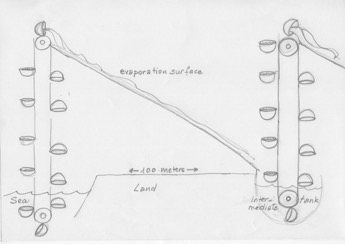
A titolo di esempio abbiamo ideato un modulo base per muovere l’acqua per una lunghezza di 100m elevandola ad una altezza di 2m .
Il Sistema è basato su una torre elevatrice a tazze che porta l’acqua in quota, l’acqua viene poi fatta scorrere su delle tegole lungo l’ipotenusa di un triangolo rettangolo che ha i due cateti uno di 2 m e l’altro di 100 m che rappresenta la base a terra.
L’acqua viene fatta scorrere con un dislivello di circa 2cm al m .
La struttura verrebbe realizzata con tubi innocenti e tegole in cemento.
Per ottenere una resa di circa 1m3 al secondo il sistema ha bisogno di un motore alla base da circa 20 KW di potenza.
Possiamo alimentare questa pompa con due strisce di pannelli solari montati lungo la struttura, potrebbero essere ad esempio 100 pannelli solari da 200 W ciascuno .
Utilizzando dei valori di mercato al dettaglio un modulo così realizzato verrebbe a costare circa 10.000€ .
Abbiamo bisogno quindi di 80 moduli se vogliamo spostare 80 m3 al secondo per 100m con un costo di 800.000€
Tale costo per la lunghezza di 1 Km si aggirerebbe sugli 8 milioni di €. Si prevede che tale costo potrebbe essere di molto abbattuto acquistando grosse quantità di materiale.
Il vantaggio del sistema così come è stato ideato risiede nell’utilizzo di tutti componenti riciclabili praticamente al 100%. Sono strutture modulari realizzate con materiale che può essere successivamente utilizzato per creare infrastrutture di varia natura utili per sviluppare le regioni che via via ridiventerebbero fertili.
Inoltre il sistema è necessario solo per innescare la ricaduta piovosa. Una volt che questa è fatta partire, i moduli possono essere utilizzati per produrre altro, compresa l’energia eletrrica e l’acqua dolce.
—versione inglese—
Absorption CO2 Project
Introduction
In order to understand the phenomenon of the “greenhouse effect” knowledge of the history of our atmosphere and namely the history of O2 is fundamental.
Our atmosphere has not always been as we see it today. Over 3.8 billion years ago, an era in which the first traces of living organisms appear, the partial pressure of O2 was about one thousandth of what it is today. The transition from a reductant atmosphere to an oxidant atmosphere took place 1.8 billion years ago. This was achieved thanks to the invention of the chlorophyll photosynthesis according to the known reaction:
6 CO2 + 6 H2O → (solar energy) → C6H12O6 + 6 O2
when solar energy combines carbon dioxide and water producing glucose with free oxygen emission.
We can reasonably assert that virtually all the oxygen available in the atmosphere has been produced by dividing the water molecule in oxygen and hydrogen thanks to the photosynthesis of organisms. Such mass of oxygen corresponds, considering the due proportions and the quantity of O2 consumed by oxidation of the rocks on the surface, to the mass of fossil fuel existing underground assessed at 10 to 22 gr. If we were to remove and burn all the fossil fuel available in the deposits we would use up all the atmosphere’s oxygen, in fact, as mentioned afore, we have a greater amount of fuel than of oxygen due to the quantity consumed through rock oxidation.
Therefore, by extracting and burning fossil fuel it is as though we are progressively returning to the condition of a primordial atmosphere, pre-life or more precisely pre-photosynthesis.
What we see today as clear and progressive global warming is however traceable to phenomena that all have a common root, the feat of the human species that in the last hundred years has increased in an exponential way the consumption of energy. Observing the phenomenon from the dynamic point of view, we can consider our planet as a closed system, we can exchange energy with our external environment, but in principle not matter. Yet the planet’s energy balance is linked to a precise balance, that can ultimately be summarised in these two:
- An internal energy production responsible for volcanic-type activities
- Energy obtained by the sun
The first type of energy we can modify marginally, while the second form of energy is strongly affected by the activities related to Mankind. For example, the oxidation of fossil fuels entails the release of solar energy accumulated at the time and trapped underground in the form of hydrocarbons. This combustion together with the heat produced by nuclear power plants represents a constant and progressive source of heat, similar to a gigantic furnace, when added to the albedo component affected by the CO2 concentration leads to the progressive rise in the temperature of our planet.
The tip of the iceberg of this phenomenon is the massive concentration of CO2 in the atmosphere which is responsible for multiple anomalies including the best known “greenhouse effect”. Similarly, it need be specified that the vast amount of O2 which is removed daily from the Earth’s atmosphere, and of which we are not well aware, is because we are tapping into our ‘buffer tank’ of oxygen represented by the ozone layer. At the same time, effects of this erosion can also be detected by an increase in the amount of UV radiation no longer shielded by the O3 at ground level. It is true that this is partially due to the use, in recent years, of fluorinated refrigerant gases and propellants, yet the reduction of the ozone layer is also partially due to the substantial amount of O2 for combustion.
The most likely future scenario to which we are fast approaching, in addition to a progressive rise in temperature, will occur with an increasing amount of UV radiation at ground level which could cause damage beyond measure to the entire ecosystem.
One of the most obvious effects, I hope I never have to see, is represented by the early yellowing of the young leaves on the branches of the trees.
The massive removal of CO2 from the atmosphere at this point can be perceived as solving the climate problem only marginally. A process would be required which could, in a certain sense, go backwards in time towards the situation of global balance at the beginning of last century, more or less to the 1950s, but how?
Are there any ways of avoiding such a major disaster?
Can the current system of the extraction and oxidation of fossil fuel so dramatically affecting our biosphere be reversed?
The priority now is to remove the CO2 from the atmosphere as effectively as possible without, however, neglecting the other phenomena mentioned earlier.
Proposal
It is known that CO2 dissolves in water. One of the most effective ways in which CO2 is naturally removed from the atmosphere is represented by the exchange surface of the ocean and by the “rain”. There is not only a way to increase rainfall, but simultaneously to allow for the consumption of CO2 and the production of oxygen as well as cooling at ground surface level. This is achieved through progressive reforestation, but there may not be enough time to obtain the required effectiveness in the short term. It would be fundamental to increase the mechanism thanks to the pattern of cultivating in “strips” or “bands” carried out in desert regions initially and by using plant species suitable to live in semi-arid regime.
An example of such a system was successfully implemented in the 70’s, in the Sahel desert, with the cultivation in “trips” or “bands” of the joba-joba.
This could lead to the gradual reforestation of desert areas, increasing the fertile surface of the planet by reversing the current trend of deforestation. We need to remind ourselves that woodlands and forests represent a very high performance “machine” for the production of O2, for the removal of CO2 and for the production of glucose in its varying forms. This carbon in the form of proto-hydrocarbon would thus be partially re-injected in the very region from which we are extracting it.
This process still needs a system that can trigger it in the short term. The following idea represents a process:
Water is required in order to trigger rainfall on the cultivated “strips” or “bands”.
This water may also be supplied in the form of steam. But, if so, fresh water is not required, salt water can also be used, that is, sea water!
There are desert areas relatively close to the coast. One could start from there. It consists in bringing sea water through a pipeline (even the existing pipelines could be used) and making it flow on waterproof black coloured grids in the open air organised in “bands” observing the distance between ONE BAND AND THE OTHER IN ORDER TO TRIGGER THE RAINY CONVECTION. Water flow rate should be well calculated to avoid complete evaporation of water and to avoid formation of evaporates. The portion of water not evaporated at the end of the cycle will then be returned to the sea with a higher saline concentration, which will be calculated so as not to affect the ecosystem where it is discharged.
The first effect of this practice would be to release large quantities of steam in the atmosphere by using solar power. The delta H evaporation will also result in a local drop of temperature, and this steam will eventually fall to the ground in the form of rain, and that is exactly what it takes to start removing CO2. Solar energy, through a photovoltaic system, can also be used for transporting water. There is also a technique for desalinating sea water, again through double-chamber solar panels, that use the temperature difference between the sea’s surface and its average depth, and that create a condensation with fresh water production, which, in turn, would be used to start farming in “strips” or “bands”.
The effectiveness of this system should therefore be represented by:
- A rapid removal of CO2 from the atmosphere
- Production of oxygen
- Crop production (food, timber, etc.)
- Employment generating
- Underground storage of proto-hydrocarbons
- Progressive cooling before delta H evaporation and subsequently as the result of the conversion of solar energy into chemical energy
Quantitative Analysis
Initial estimates have been calculated in order to assess the size of the surface that would make a significant contribution.
a) 3,5 x 10¹³ Kg / Year = CO2 produced every year
b) 1 Kg of petroleum = 12 Kw/h with 1,5 Kg of CO2 produced, 1 Kg of O2 consumed and 0,5 Kg of H2O produced
c) 8 KW/h in one day = Solar energy
d) ideal yield —— 1,5 days x 1 m2 (exposed by the Sun) = 1 Kg of petroleum I. e. 1,5 days x 1 m2 (exposed by the Sun) correspond to 1,5 Kg of CO2 removed from the atmosphere and 1 kg of O2 produced if all solar energy is converted in chemical energy by photosynthesis
real yield is about 20% therefore:
e) 5 m2 (exposed by the Sun) = 1 Kg of CO2 removed from the atmosphere
f) 5 m2 (exposed by the Sun) x one year = 365 Kg of CO2 removed
g) ratio between CO2 produced and CO2 removed =
3,5 x 10 13 /365×5 = 5×10 11 m2 (about one of Australian desert surface)
To sum up
Using the desert zones present on our planet through the system of a network of evaporators in bands and the ensuing rainfall and reforestation of these areas, it would be possible to reverse the present tendency of global warming not only in an eco-friendly manner, but beneficial in a number of other ways, including that of not being in a particular hurry related to the conversion period between fossil fuels, nuclear and renewable sources. Building a suitable matrix of waterproof channels in open-air on which to pour sea water in desert areas an approximate amount of CO2 can be removed equivalent to 0,2Kg/m2 per day.
Study of feasibility
Let us consider a thickness of H20 equivalent to 0,005 meters we have a total volume equal to
5 x 10¹¹ m2 x 0,005 m of approximately 2,5 x 10⁹ m3.
We can think of a pumping system that in a year fills this volume using a pump that supplies approximately 80 m3 per second, the equivalent of 6 times the aqueduct of Peschiera, one of the aqueducts that supplies the city of Rome.
As an example, we have created a basic module to propel water for the length of 100 meters by raising it to a height of 2 meters.
The system is based on a bucket elevator tower that carries the water upward and the water then slides over tiles along the hypotenuse of a triangle rectangle with its two sides, one measuring 2 meters and the other, representing the base on the ground, measuring 100 meters.
The water is made to flow with a difference in height of about 2 cm per meter.
The structure would be made of “Innocenti” metal tubes and concrete tiles.
To achieve an output of about 1 meter3 per second the system needs a 20KW powered engine at the base. The pump can be powered by two strips of solar panels mounted along the structure, which could be, for example, 100 solar panels pf 200 W each.
Using retail market values, such a module would cost € 10.000.
So 80 modules are needed if we are to propel 80 m3 per second for 100 meters at the cost of
€ 800.000. This cost, for the length of 1 Km, is estimated at € 8 million. It is expected that this cost could be greatly reduced by purchasing large quantities of material.
The advantage of this system as it was designed lies in the use of all recyclable components up to 100%. They are all modular structures made from material that can later be used to create infrastructures of various kinds to develop the regions which would gradually become fertile.
In addition, the system is only needed to trigger rainy relapse. Once this has initiated, the modules can be used to produce something else including electric energy and fresh water.
Example of the movement of sea water
In conclusion
Through the evaporation of sea water in the desert you obtain:
1) Global cooling due to “∆H evaporation”
2) The triggering of a rainy fallout resulting in an increase of the area of exchange between CO2 and H20
3) If the evaporation is undertaken through the geometrically based strips the rainy fallout will be “in situ”, the effect would therefore result in having fresh water in the desert, subsequently setting off reforestation a virtuous process of spontaneous production of O2 and CO2 removal, the latter would be later trapped underground in the form of hydrocarbons in the very places from which they were extracted.
Team Project conceived by Dr Massimo Claro and Dr Diana Callea. 18/04/2021 – Biella, Italy